Book writing software for writing a novel in Thai
Thai writes no spaces between words, so Galley counts it in characters and the unit follows through every screen. Two faces are cut for Thai, the stacked marks are drawn and not piled, and Amazon does not sell Thai at all.
การเขียนนวนิยายภาษาไทย
Galley คือที่ที่คุณเขียนนวนิยายและทำมันให้เป็นหนังสือ คุณเขียนบนหน้าหนังสือจริงตั้งแต่ประโยคแรก ทั้งขนาดเล่ม ขอบกระดาษ และแบบอักษรที่จะพิมพ์
มีแบบอักษรสำหรับหนังสือสองแบบ ทั้งคู่มีสัญญาอนุญาตแบบเสรี คุณจึงขายสิ่งที่คุณพิมพ์ได้ และจำนวนนับเป็นตัวอักษร ไม่ใช่คำ
สุดท้ายคุณจะได้ไฟล์ PDF ที่พร้อมส่งโรงพิมพ์และไฟล์ EPUB ที่ถูกต้อง หน้าจอโปรแกรมเป็นภาษาอังกฤษ แต่หนังสือเป็นภาษาไทย
Why Galley is the right book writing software for a novel in Thai
Thai breaks two things that most software does not know are breakable.
Counting. Thai writes no spaces between words. Split on whitespace and a Thai paragraph counts as one or two words, which makes every number in the app a lie: the word count, the reading time, the page-count projection, the chart of chapter lengths. Galley counts a Thai book in characters and carries that unit through every screen that shows a number, with its own reading-speed constant instead of the English one.
Stacking. Thai puts a vowel above or below a consonant and a tone mark above that, two levels of marks over one letter. A face that carries the Thai block but was not drawn for the stacking piles the glyphs and they collide. Both faces on the Thai shelf are drawn for it.
Thai also hides its own line-breaking problem, which is worth knowing if you are comparing tools: Thai prose carries spaces between phrases, so a naive line breaker that only breaks on whitespace appears to work in Thai while failing completely in Japanese and Chinese. It is working by accident. Galley breaks Thai with the prohibition rules applied to the Latin punctuation Thai borrows.
Amazon does not list Thai in any format, so the print-ready PDF and the valid EPUB are the whole product.
Everything else is the same app: a true book page at your trim, the story bible beside the manuscript, a print-ready PDF and a valid EPUB.
How Thai gets typeset
The unit is characters, everywhere in the app.
Spaces are not decorated in the Invisibles view, because a dot on every space in a script that uses spaces as phrase separators would be noise.
Sentence marks are not assumed. Thai does not end sentences with a full stop, so the app does not report a sentence count for a Thai book instead of reporting a wrong one.
Leading matters more than in Latin. Two levels of marks above a letter need room, and a Thai page set at English leading looks cramped.
There is no italic tradition, so the button is hidden.
There is no hyphenation, and justification is off by default.
The typefaces you get for Thai
Two faces, both under the SIL Open Font License.
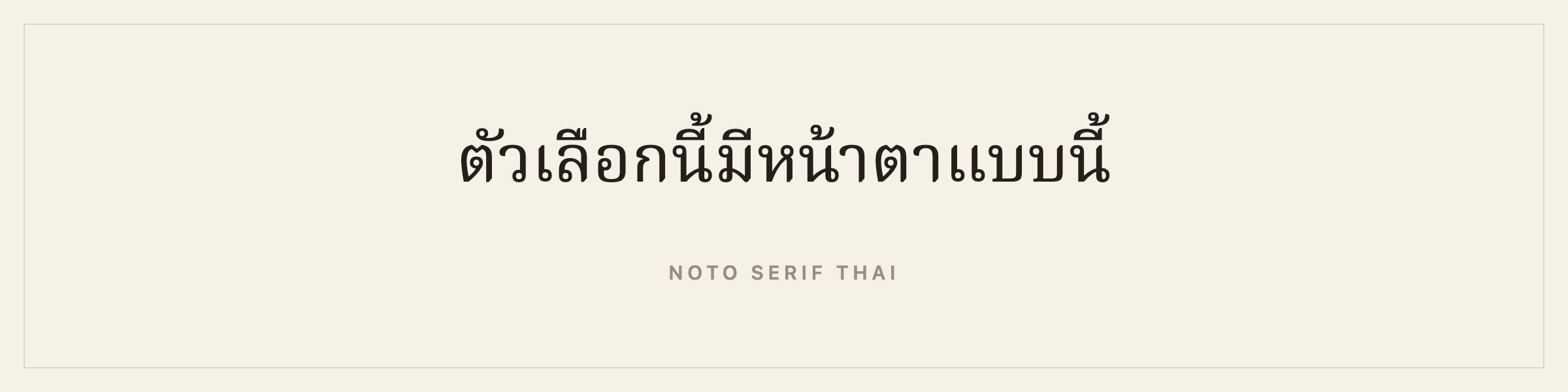
Noto Serif Thai is the reliable default with the broadest coverage.
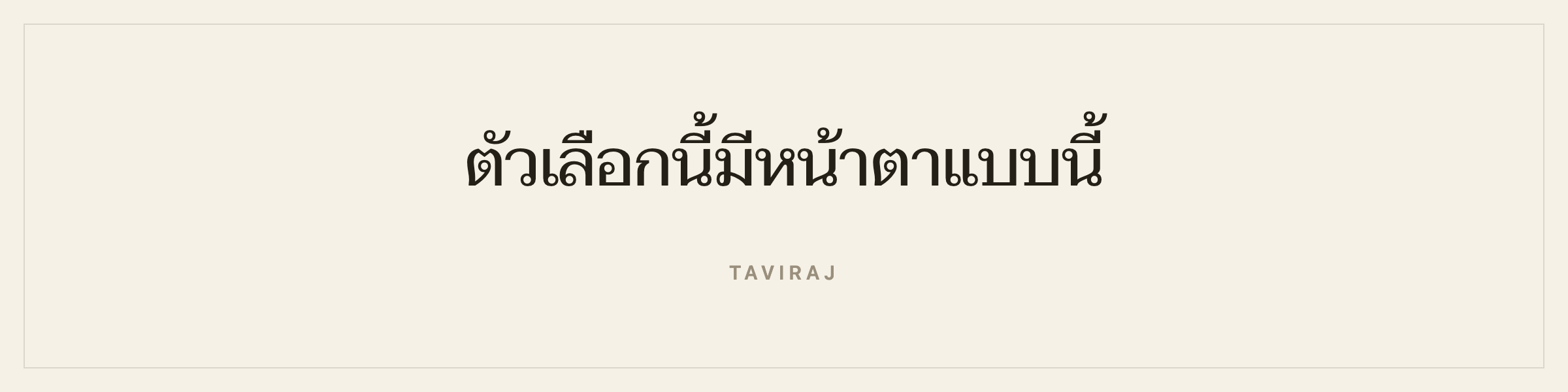
Taviraj is the more literary of the two, with looped terminals in the traditional style.
Two faces is a thin shelf, and it is the state of free Thai book type, not a decision anyone made here. The typeface documentation lists every face by language.
Exports for a Thai novel
- Print-ready PDF at your trim, mirrored margins, real gutter, font embedded.
- EPUB 3 with your cover, tagged
th. - Store-ready EPUBs for Kobo and Apple Books.
- Word and Markdown for an editor or an archive.
- Manuscript format, double-spaced, set in the book’s own face and counting in characters.
- A proofreading PDF two pages to a sheet, and a large print PDF.
- A watermarked copy per beta reader.
The Amazon-shaped tools switch off on a Thai book and say why.
Thai punctuation
Thai sets speech in the curly double pair, which is what Galley types on a Thai book. The paiyannoi and the mai yamok are ordinary characters that survive typing and both exports.
Chapter headings are still the English default on a Thai book. Getting the Thai convention right wants a native reader, not a guess, so the app lets you title chapters yourself. If you write in Thai and want to tell me what it should be, say so.
How long a Thai novel is
In characters, which is how Galley counts it. Thai publishers quote length in pages and in printed sheets, and the app’s page-count projection at your trim is the number that converts to sheets.
The word count to page count converter works in words, so use the app’s own projection for a Thai book.
Trim sizes for a Thai book
Six standards, from mass market at 4.25×6.87 inches to Royal at 6.14×9.21. Thai trade fiction is commonly issued around 14.5×21cm, between the Digest at 5.5×8.5 inches and Royal. The spine width calculator and the trim size comparison would be helpful here.
Metadata and the copyright page
The copyright page writes itself from the metadata you filled in. Every field detects its own script, so a Thai title and a Latin ISBN both come out right, and the download filename keeps its Thai. A Thai ISBN comes from the National Library of Thailand.
Translating into or out of Thai
A translation in Galley is its own book: its own language, its own typeface shelf, its own ISBN, its own cover, still linked to the original, with the editor split so the original sits read-only beside what you write. A Thai edition of an English novel switches to character counting on its own, because the counting mode follows the language.
There are pages on writing a novel in Vietnamese, writing a novel in Bengali and writing a novel in Korean.
No machine touches the prose. Galley has no AI anywhere near your writing.
Self-publishing and traditional publishing in Thai
Self-publishing. Amazon is closed, so print goes through a Thai printer or IngramSpark and the ebook goes to Google Play, Apple Books, Kobo or a Thai store. Domestic print in Thailand is cheap enough that a local run is often the better economics anyway.
Traditional publishing. Thai publishing runs through established houses and the book fair calendar. The submission package assembles the synopsis, the bio and the opening chapters.
The same book exports both. The longer arguments are in Galley for self-publishing and Galley for traditional publishing.
Where to go next
- Writing software for novelists who don’t write in English covers every script Galley sets.
- Book design and typefaces lists every face by language.
- Series and translations covers the full language list.
- EPUB vs print PDF explains what each format can do.
Questions people ask about writing a novel in Thai
How does Galley count a Thai book?
In characters. Thai writes no spaces between words, so a word count would be meaningless, and the character unit follows through every screen that shows a number, including the reading-time estimate.
Which Thai fonts does Galley include?
Noto Serif Thai and Taviraj, both under the SIL Open Font License so Galley can embed them in a file you sell.
Can I sell a Thai book on Amazon KDP?
No. Amazon does not list Thai in any format. The print PDF goes to a Thai printer or IngramSpark, and the EPUB goes to any store that sells Thai.
Do the stacked tone marks come out correctly?
Yes, in both faces on the shelf. A Thai vowel can sit above a consonant with a tone mark above that, and the face has to draw the stack instead of piling two glyphs.
Other languages
- Book writing software for VietnameseWrite and typeset a Vietnamese novel: stacked diacritics that do not collide, twelve book faces that carry the full set, and a print-ready PDF for a Vietnamese printer.
- Book writing software for BengaliWrite and typeset a Bengali novel: conjuncts shaped properly in the print PDF, two book faces cut for Bangla, matras that survive search, and a print-ready file for a Kolkata or Dhaka printer.
- Book writing software for KoreanWrite and typeset a Korean novel: Myeongjo faces embedded in the print PDF, Korean chapter headings, word counting that works because Korean spaces its words, and a print-ready file.