A Self-Editing Checklist for Your Novel
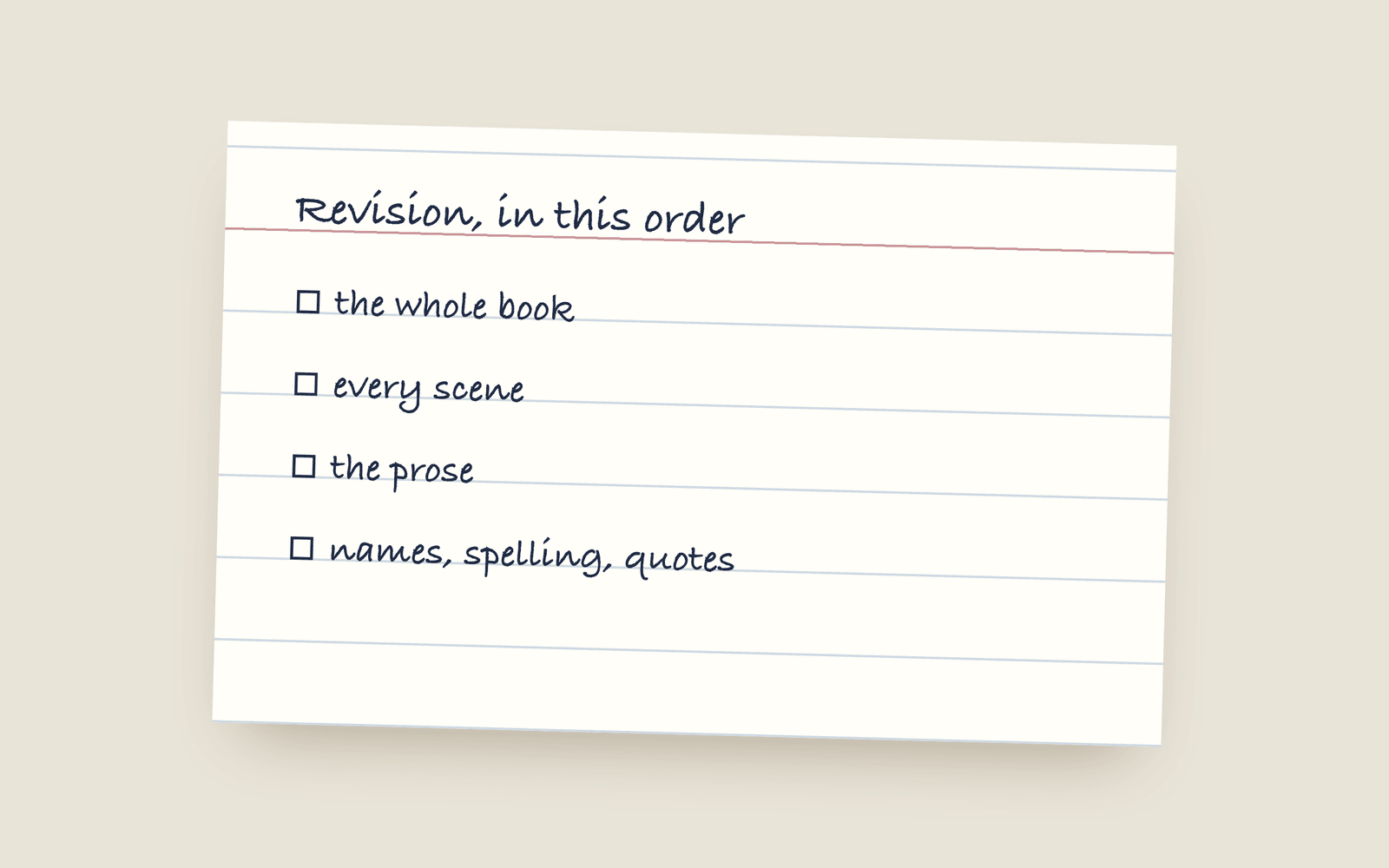
Edit from the big things down to the small ones, so you don't polish sentences in a scene you're about to cut. Start with structure and the main character's arc, then each scene, then the prose, and leave typos and consistency for the last pass. Take a break between finishing the draft and starting, and read it in a different format from the one you wrote it in.
The biggest mistake in self-editing is doing it in the wrong order. If you start by fixing commas, you’ll spend a week on a chapter that you later realise has to go. Editors work from the top down for a reason: a developmental edit first, then a line edit, then a copyedit, then a proofread.
So this checklist goes in that order. Do one pass at a time.
Before you start
- Leave it alone for a few weeks. Stephen King says six. Even two helps. You need to forget what you meant so you can see what you wrote.
- Read it in a different format. If you wrote it on a laptop, read it on a tablet, or print it. Your eye skips less on a page that looks unfamiliar.
- Read it in one go if you can. Pacing problems only show up when you read the book at the speed a reader would.
Pass one: the whole book
- Does the story start in the right place? A lot of first drafts begin a chapter or two early.
- Does the main character want something by the end of the first act, and is it clear what’s in the way?
- Does every subplot finish, or at least get acknowledged?
- Is there a stretch in the middle where nothing changes? Note the chapters.
- Does the ending pay off what the opening set up?
- Is anything out of order in time? (A timeline is the easiest way to check this. See continuity errors.)
Don’t fix anything in this pass. Make a list.
Pass two: each scene
For every scene, ask:
- What does the point-of-view character want here?
- What’s different at the end of the scene?
- Could it be cut without the reader missing anything? If yes, cut it or merge it.
- Does it start late and leave early? Most scenes can lose their first and last paragraphs.
Pass three: the prose
- Repetition. The words you lean on. Everyone has them, and you can’t see your own. Count them (there’s a whole post on overused words).
- Filter words. “She saw”, “he felt”, “she noticed”. Usually the sentence is stronger without them.
- Dialogue tags. Mostly “said”. Cut the adverbs attached to them.
- Sentence rhythm. Read a page out loud. If you run out of breath, or every sentence is the same length, it’ll show.
- Description the reader doesn’t need. Rooms we never come back to, clothes that don’t matter.
Pass four: the mechanical stuff
This is the copyedit pass, and it’s the one software is best at.
- Names. Every character spelled the same way all the way through, and nicknames used consistently.
- Spelling family. British or American, not both.
- Hyphenation. Pick “well-being” or “wellbeing” and stick to it. Write it down in a style sheet.
- Punctuation. Straight quotes pasted in from somewhere, double spaces, three dots instead of an ellipsis.
- Numbers. Spelled out or digits, consistently.
Then send it out
After the four passes, the book is ready for other people. Sending it to beta readers covers what to ask them.
How Galley does it
Galley doesn’t do the first three passes for you, and nothing in it rewrites a sentence. What it does is make them easier. Read-through shows the whole book as one page, so pass one is a read rather than forty clicks, and the Stats panel shows the chapters that are much longer or shorter than the rest. For pass four, overused words counts your repeats per thousand words and shows where each one peaks, name consistency finds the Sara among the Sarahs, and the consistency sweep flags mixed spellings, hyphenation, quotes and number style (skipping dialogue, because characters are allowed to talk how they talk). It’s all on the revision page, and the docs go through each check.
More on craft
- Conan Doyle Used “Upon” 465 Times: Overused Words in FictionThe filler words fiction editors cut first, real counts from The Adventures of Sherlock Holmes, and how to find your own habits without reading the whole draft again.
- How Many Words Should a Chapter Be?Typical chapter lengths in novels by genre, why there's no rule, and how to tell whether one of your chapters is too long or too short for the book around it.
- How Long Should a Novel Be? Word Counts by GenreThe word-count ranges agents and readers actually expect (fantasy, romance, thriller, YA, literary), and what to do if you're way over or under.