Conan Doyle Used “Upon” 465 Times: Overused Words in Fiction
Every writer leans on a few words without noticing. Editors cut the same ones over and over: just, that, very, really, quite, suddenly, and filter verbs like felt and seemed. What helps is knowing your own counts and the chapter where each one bunches up, which one report gives you without another full re-read.
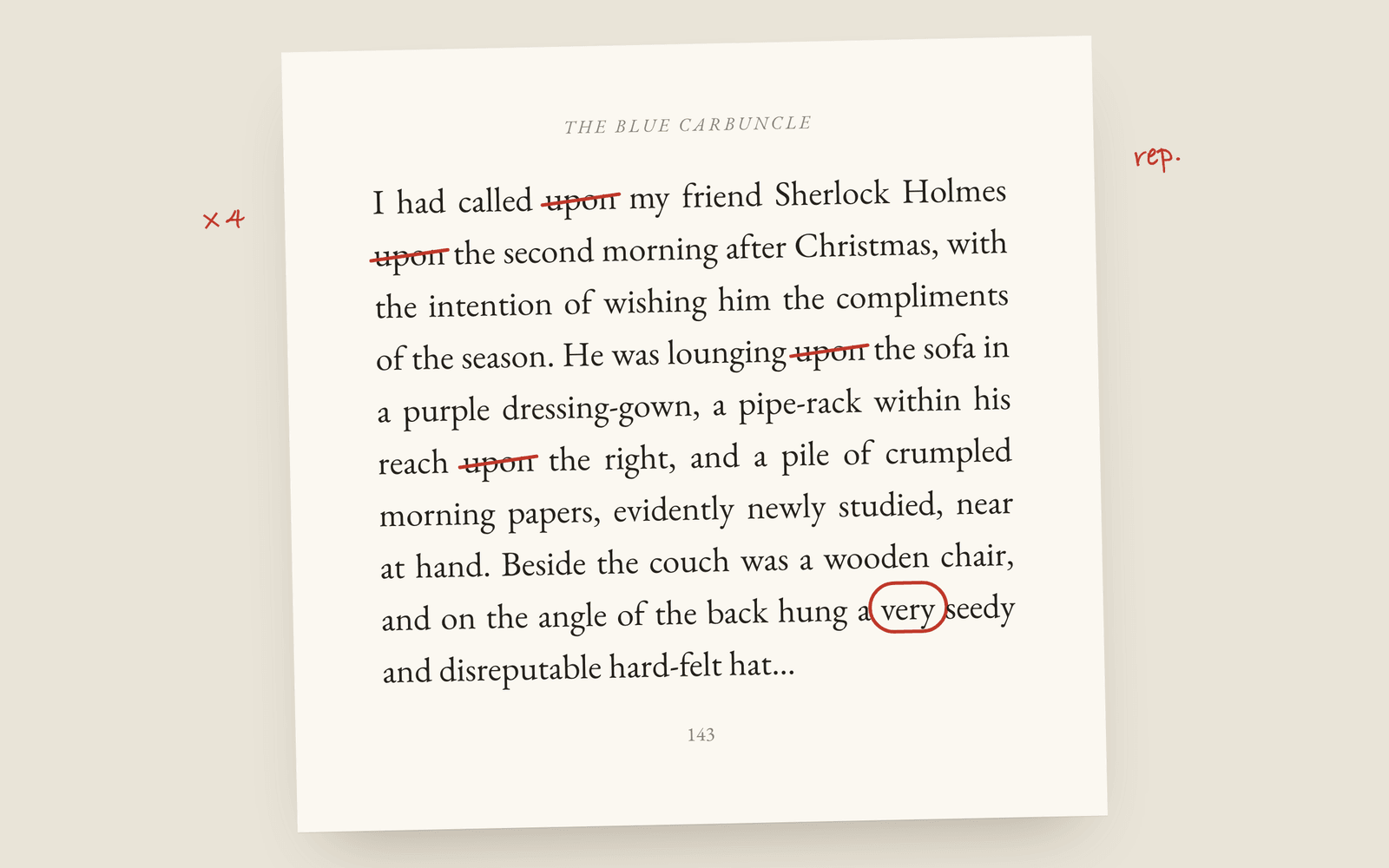
Arthur Conan Doyle used the word “upon” 465 times in The Adventures of Sherlock Holmes. The book is about 104,000 words long, so that’s roughly one “upon” every 225 words, and nobody in 1892 seems to have minded. Holmes is “lounging upon the sofa”, there’s a pipe-rack “upon the right”, Watson calls “upon my friend”. It’s a Victorian habit more than a Doyle one, but it’s still a habit, and it’s exactly the kind of thing you stop seeing in your own writing after the third draft.
You can’t find overused words by reading, because your brain reads past them, so you need them counted.
The words editors cut first
If you’ve read a few editor blogs (or had a manuscript come back covered in red), the list is pretty consistent. Galley’s filler watchlist covers the same words:
| Word | Why it gets cut |
|---|---|
| just | Almost always removable. Keep it only when it means “only” (“it’s just me”). |
| that | Usually optional after verbs. “She said that she’d come” works fine as “She said she’d come”. |
| very, really, quite | A sign the word next to them is too weak. “Very tired” is usually “exhausted”. |
| suddenly | If something happens, it already happened suddenly. |
| actually, definitely | Emphasis you don’t need, mostly in dialogue tags and narration. |
| seemed, felt, noticed, realized | Filter words. They put the character between the reader and what happens. |
| began, started | “She began to run” is slower than “she ran”, and usually means the same. |
| almost, slightly, somehow, rather | Hedges. Fine once in a while, tiring in bulk. |
None of these are banned. “Just” in dialogue sounds like a person talking, and a narrator who hedges might be a narrator who hedges on purpose. The point is to know how often you’re doing it.
What the counts look like on a real book
Here’s what Galley’s overused words report says about the Holmes stories. It’s the actual output, run on the Project Gutenberg text:
| Word | Count | Per 1,000 words | Peaks in |
|---|---|---|---|
| that | 1,744 | 16.7 | The Beryl Coronet (185) |
| very | 400 | 3.8 | The Noble Bachelor (53) |
| just | 126 | 1.2 | The Noble Bachelor (19) |
| quite | 107 | 1.0 | The Copper Beeches (22) |
| seemed | 69 | 0.7 | The Copper Beeches (12) |
“That” is huge, but it’s huge in almost every book, so on its own it doesn’t mean much. The more useful column is the last one. “Very” shows up 53 times in The Noble Bachelor, which is one of the shorter stories, so if I were Doyle’s editor that’s the chapter I’d open first.
The same report also lists the words you repeat most that aren’t on the watchlist. For Holmes that’s “upon” (465), “little” (269), “well” (188) and “shall” (169). “Little” is the one I’d look at, because it’s doing a lot of describing: little problems, little points, a little man.
How to find your own
You can do this by hand with find and replace, one word at a time, and write the counts down. It works, it just takes an evening, and you won’t get the per-chapter breakdown without a spreadsheet.
In Galley it’s one report. Open Overused words from the Toolkit & Exports menu and you get the watchlist with counts, the rate per thousand, the chapter where each word peaks, and your most repeated words underneath. Then ⌘F takes you to each one in the text. There’s more on how it counts (and what it ignores) in the revision docs.
What I’d do with the numbers:
- Ignore the totals at first. Look at the rate per thousand. One “just” every 500 words is normal. One every 80 is a habit.
- Start with the peak chapter. If a word bunches up in one chapter, that chapter was probably written fast, or late at night, or both.
- Cut in context, not in bulk. Replacing every “very” in one go is how you end up with “exhausted” six times on a page. Read the sentence, then decide.
- Run it again after the pass. It’s useful to see the number drop, mostly so you know when to stop.
It’s also worth running name consistency in the same sitting, since it’s the other thing you can’t see by reading: one “Sara” in a book full of “Sarah”s.
Do readers actually notice?
Mostly not, one word at a time. What they notice is the rhythm. A page where every other sentence has “just” in it reads breathless, and a chapter full of “seemed” and “felt” reads like the narrator is standing a few feet back from the action. Readers don’t write “too many fillers” in a review. They write that it “dragged” or “felt flat”.
And to be fair to Doyle, “upon” 465 times is part of why the stories sound like they do. If your crutch word is doing that much for your voice, keep it. If it isn’t, it’s probably “just” 🙃
The Galley demo has a sample book loaded if you want to see the report run, and the Holmes example is on the revision page too.
More on craft
- How Many Words Should a Chapter Be?Typical chapter lengths in novels by genre, why there's no rule, and how to tell whether one of your chapters is too long or too short for the book around it.
- How Long Should a Novel Be? Word Counts by GenreThe word-count ranges agents and readers actually expect (fantasy, romance, thriller, YA, literary), and what to do if you're way over or under.
- A Series Bible for Book Two and BeyondWhat a series bible holds that a single book's notes don't, how to start one when you're already a book in, and how to carry it into the next book.