Continuity Errors in Fiction, and How to Catch Them
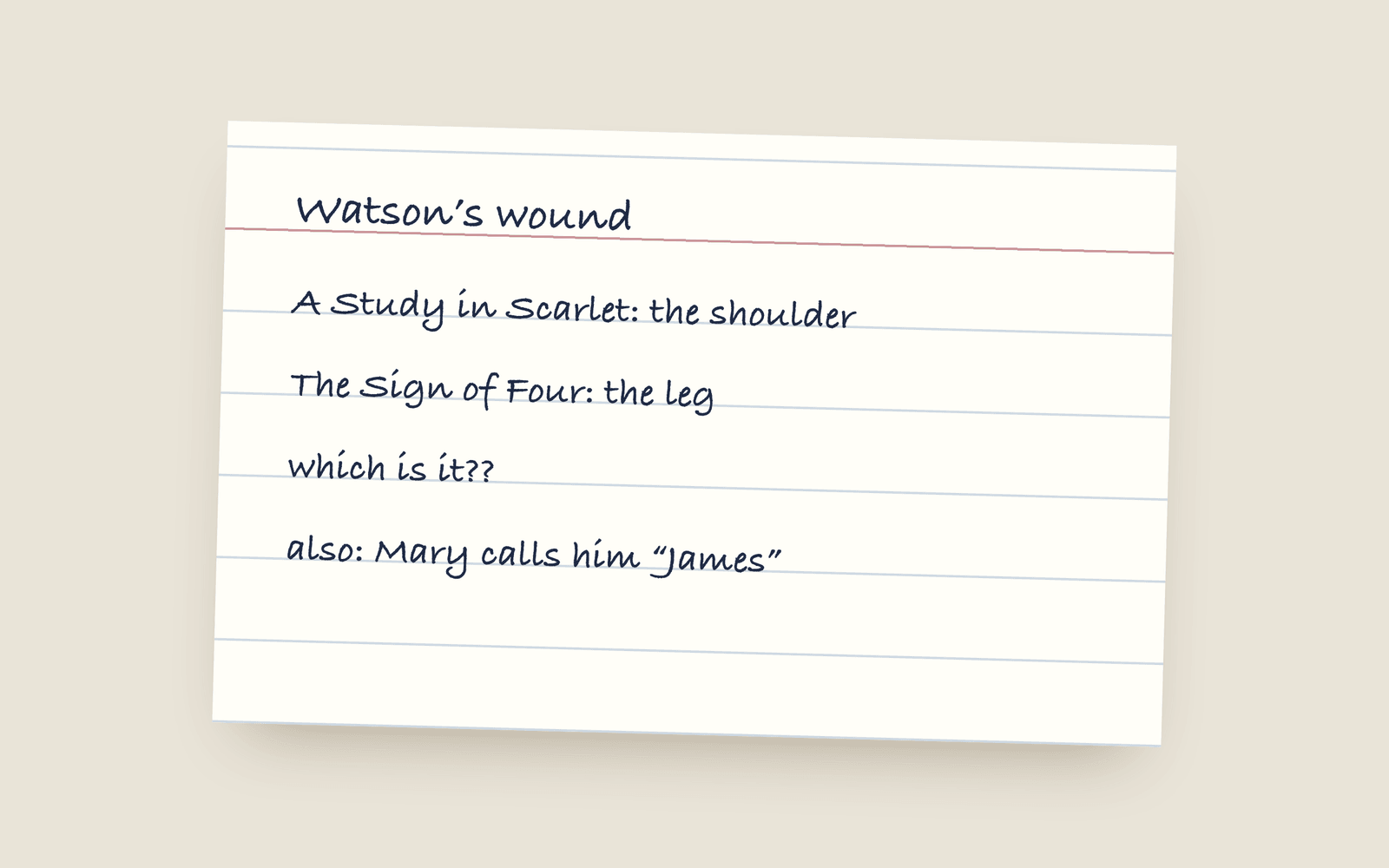
Continuity errors are facts that change without the story meaning them to: a wound that moves, a name that changes, a Tuesday that should be a Thursday. Even Conan Doyle moved Watson's war wound from his shoulder to his leg. Keep a story bible as you write, put events on a timeline with your story's own dates, and check physical details, time, places and who knows what.
In A Study in Scarlet, the first Sherlock Holmes novel, Dr Watson was hit in the shoulder by a Jezail bullet in Afghanistan. In The Sign of Four, the second, he rests his hand on his leg, which “had a Jezail bullet through it some time before”. Readers have been arguing about it since 1890. Then in “The Man with the Twisted Lip”, Watson’s wife calls him James, although his name is John.
Conan Doyle was writing fast, for magazines, and nobody kept his notes for him. You probably are too, in your own way. And readers love finding these.
The four kinds
Physical details. Eye colour, height, scars, the car someone drives, which hand they write with. The more specific the detail, the more likely it is to change, because you made it up on the spot and didn’t write it down.
Time. The big one. A pregnancy that lasts eleven months. A character who’s 30 in chapter one and 34 in chapter eight, with only a summer in between. A Tuesday that’s a Thursday two pages later. Seasons that don’t move. Somebody who goes to a funeral two chapters after they left the country.
Places. The house has two floors in one chapter and three in another. The walk to the village is ten minutes, then an hour. The kitchen window looks out onto the garden, until it looks onto the street.
Knowledge. A character who knows something they weren’t there for. This is the subtle one, and it’s the one editors flag most. If the reader saw the letter but she didn’t, she can’t mention what’s in it.
How to catch them
Write it down the first time. Every time you invent a fact about a person or a place, put it somewhere you’ll look again. That’s what a story bible is for. It doesn’t need to be elaborate: eye colour, age, the layout of the house.
Give the story a timeline. Use your story’s own dates, not real ones: “Day 1”, “the second week of June”, “three years after the fire”. Put every event on it and link it to the chapter it happens in. Most time errors show up the moment the events are in a line.
Track who knows what. For a mystery or a thriller, a simple table of the big secrets and the chapter each character learns them saves a lot of pain.
Read it straight through. Continuity errors hide when you read a chapter at a time over a month. Read the book in two or three sittings, in order, with a notebook.
Ask a beta reader to look for them. Some people are very good at this and enjoy it. Ask specifically. “Tell me anything that doesn’t add up” gets a different read from “what did you think?”
How Galley does it
Galley’s story bible sits in tabs on the book: characters, locations, a timeline and world-building. Each character page has their sections (appearance, background, whatever you name), the chapters they appear in, counted from the text, and the timeline events they’re part of.
The timeline uses your story’s dates and links each event to its chapters, characters and places, which is how you spot the funeral after the flight. Read-through shows the whole book as one page for the straight-through read. Galley won’t tell you a fact contradicts itself, because it doesn’t read your prose for meaning and there’s no AI in it, but it puts the facts where you’ll see them.
More on craft
- Conan Doyle Used “Upon” 465 Times: Overused Words in FictionThe filler words fiction editors cut first, real counts from The Adventures of Sherlock Holmes, and how to find your own habits without reading the whole draft again.
- How Many Words Should a Chapter Be?Typical chapter lengths in novels by genre, why there's no rule, and how to tell whether one of your chapters is too long or too short for the book around it.
- How Long Should a Novel Be? Word Counts by GenreThe word-count ranges agents and readers actually expect (fantasy, romance, thriller, YA, literary), and what to do if you're way over or under.