What a Style Sheet Is, and Why Your Copyeditor Will Ask for One
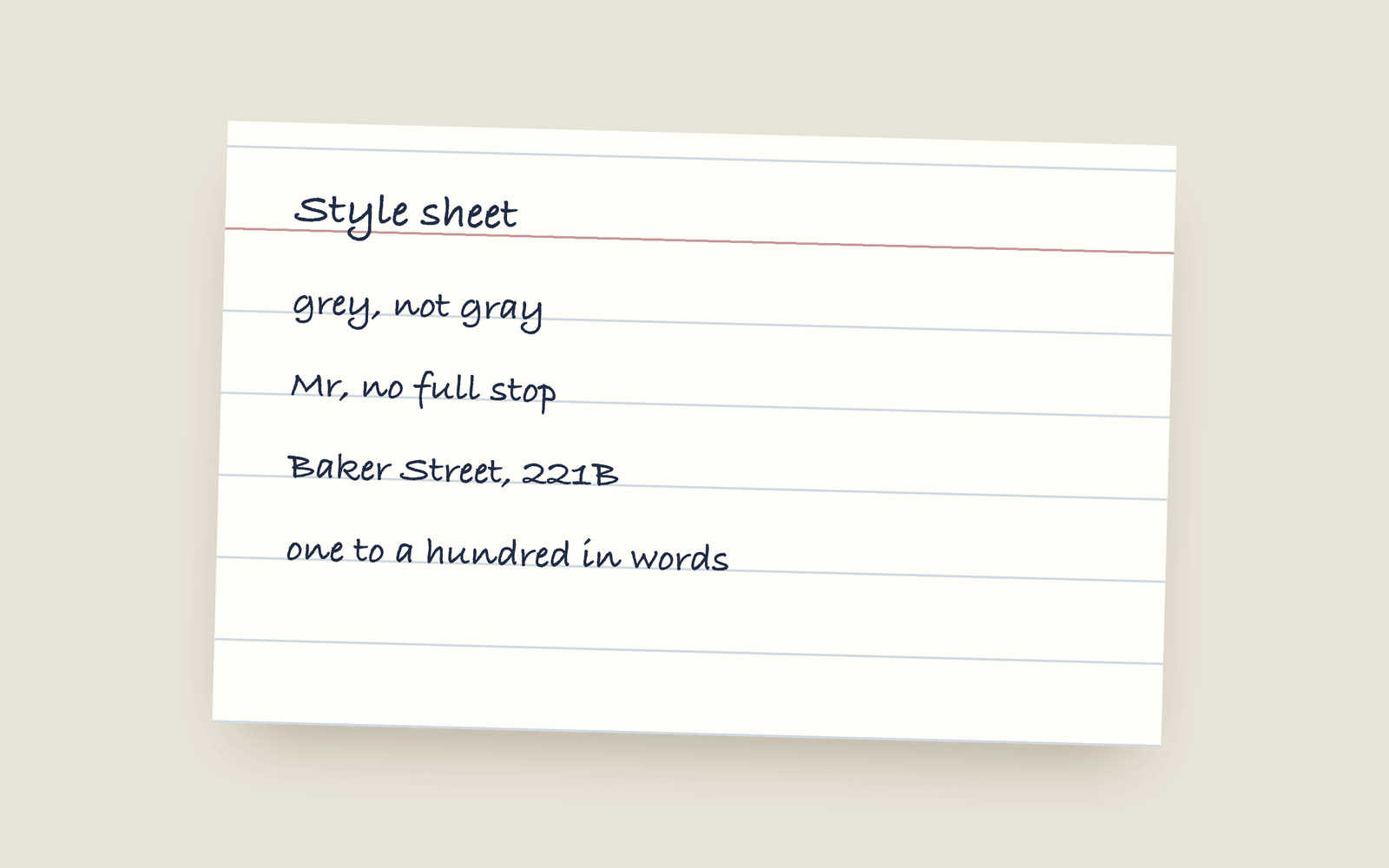
A style sheet is a list of every spelling, capitalisation, hyphenation and number decision in your book, plus the names and a few key facts. Copyeditors build one for every manuscript so the book is consistent with itself. If you start your own while you write, you only make each decision once, and the copyedit is faster and cheaper.
When a copyeditor works on your novel, they keep a document beside it. Every time they make a decision (“grey, not gray”, “OK, not okay”, “the Old Town, capitalised”), it goes on the list, so the same word is handled the same way in chapter twenty-three. That list is the style sheet. At the end it comes back to you with the manuscript, and the proofreader works from it later.
Publishers have house style guides for the general rules. The style sheet is for the decisions that belong to your book.
What’s on one
| Section | Examples |
|---|---|
| Spelling | grey, judgement, OK, email, Mr (no full stop, UK) |
| Names | every character and place, spelled once, with nicknames |
| Hyphenation | well-being, a long-term plan, the long term, ten-year-old girl |
| Capitalisation | the Inspector (title) but an inspector (job), the Thames, the north of England |
| Numbers | spell out one to a hundred, digits for years and times, 221B |
| Invented words | spells, places, slang, with how they’re spelled and whether they’re italic |
| Punctuation | serial comma or not, single or double quotes, spaced en dash or closed em dash |
| Key facts | ages, dates, eye colours, the layout of the house |
That last row overlaps with a story bible, and some writers keep them together. The difference is that a style sheet is about how words appear on the page, and a story bible is about what’s true in the story.
Why start one yourself
Most of the inconsistencies a copyeditor fixes are ones you created by deciding the same thing twice, a few months apart. “Toward” in chapter three, “towards” in chapter nineteen. If you’d written “towards” down the first time, you’d have stopped thinking about it.
It also saves you money. Copyeditors charge by the word or the hour, and a manuscript that’s already consistent is quicker to edit. And it makes the conversation easier: if your copyeditor sees “grey” on your sheet, they know it’s a choice and not a mistake.
If you’re writing a series, the style sheet is how book three matches book one. (The series bible post has more on that.)
Picking the rules
If you’re not sure which way to go on the general rules, pick a regional standard and follow it. US fiction mostly follows the Chicago Manual of Style, and UK fiction follows New Hart’s Rules or a publisher’s own guide. The UK vs US style page has the main differences side by side, from quote marks to “-ise” and “-ize”.
How Galley does it
Every book in Galley has a Style sheet tab in the story bible, where you write your decisions down as you make them. The names live on the character and location pages next to it.
The consistency sweep then checks the book against itself: British and American spellings mixed together, a word hyphenated two different ways, straight quotes, double spaces, and small numbers in digits where publishers usually spell them out. It tells you which spelling the book mostly uses and lists the ones that don’t match, and it skips dialogue, because a character can say “colour” in an American book. It doesn’t change anything for you. The revision docs list everything it looks for, and the glossary has the short definition.
More on craft
- Conan Doyle Used “Upon” 465 Times: Overused Words in FictionThe filler words fiction editors cut first, real counts from The Adventures of Sherlock Holmes, and how to find your own habits without reading the whole draft again.
- How Many Words Should a Chapter Be?Typical chapter lengths in novels by genre, why there's no rule, and how to tell whether one of your chapters is too long or too short for the book around it.
- How Long Should a Novel Be? Word Counts by GenreThe word-count ranges agents and readers actually expect (fantasy, romance, thriller, YA, literary), and what to do if you're way over or under.