How Many Words Should a Chapter Be?
Most novel chapters run between 2,000 and 5,000 words, with thrillers at the short end and literary fiction and fantasy at the long end. There's no rule. What matters is consistency inside your own book: a chapter twice as long as its neighbours, or one a quarter of the length, is worth a second look.
There isn’t a correct length for a chapter. If anyone tells you there is, they’re thinking of one genre. But there are ranges most books sit in, and they’re useful to know when you’re wondering why chapter fourteen feels like it goes on forever.
The usual ranges
| Genre | Typical chapter length |
|---|---|
| Thriller and crime | 1,500 to 3,000 words |
| Romance | 2,500 to 4,000 words |
| Young adult | 2,000 to 4,000 words |
| Fantasy and science fiction | 3,000 to 6,000 words |
| Literary fiction | 3,000 to 6,000 words, and all over the place |
Thrillers run short because a chapter break is a cliffhanger, and more breaks mean more of them. Literary fiction runs long because the chapter is often a whole movement of the story. Neither is better.
At 250 to 300 words a printed page, a 3,000-word chapter is about ten to twelve pages. The word count to page count calculator will do that for your trim and typeface.
What a real book looks like
The Adventures of Sherlock Holmes isn’t a novel, it’s twelve stories, but each story works like a long chapter, so it’s a decent example of a book with a steady rhythm. Here are the lengths:
| Story | Words |
|---|---|
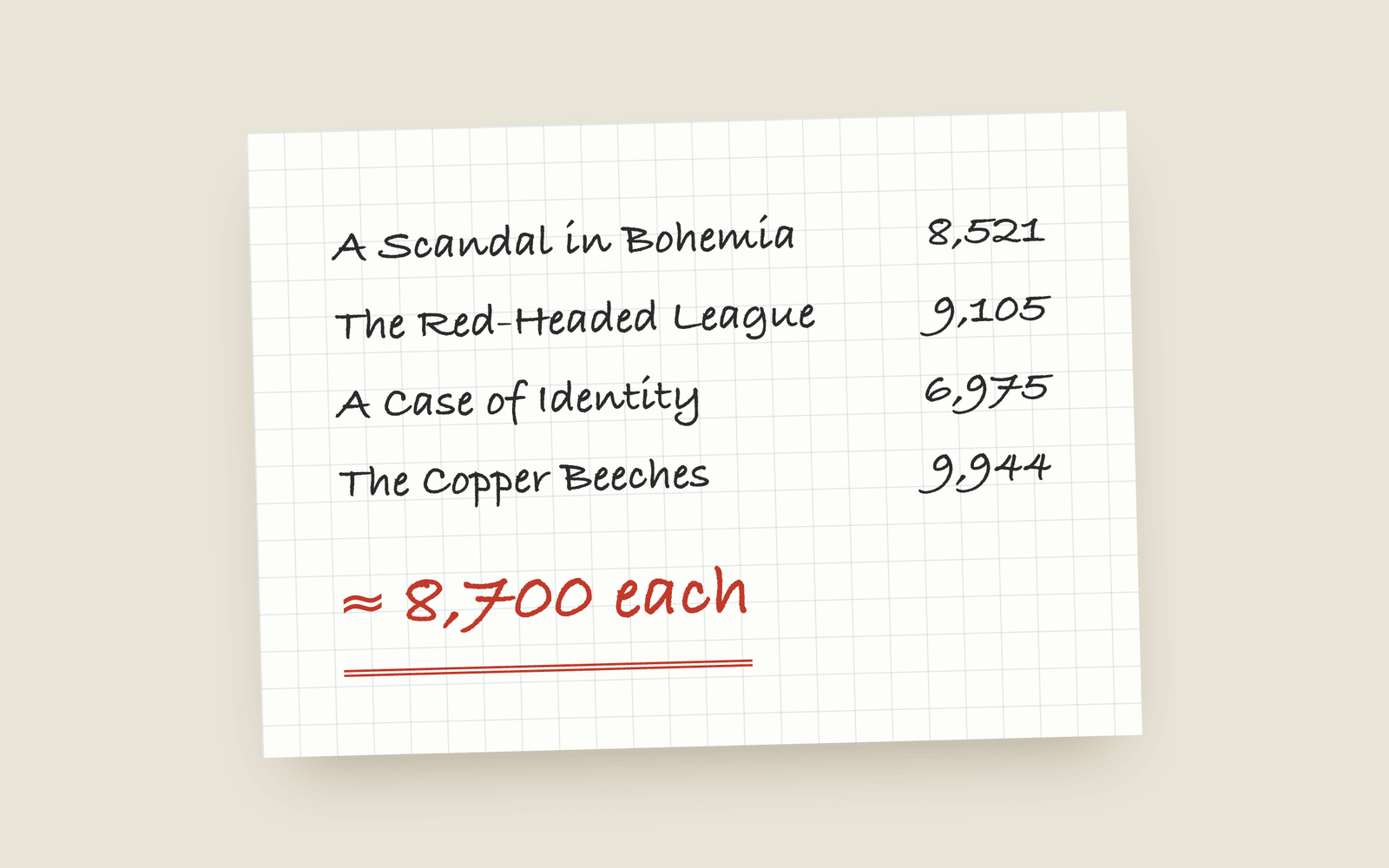
| A Scandal in Bohemia | 8,521 |
| The Red-Headed League | 9,105 |
| A Case of Identity | 6,975 |
| The Boscombe Valley Mystery | 9,615 |
| The Five Orange Pips | 7,314 |
| The Man with the Twisted Lip | 9,199 |
| The Blue Carbuncle | 7,808 |
| The Speckled Band | 9,805 |
| The Engineer’s Thumb | 8,283 |
| The Noble Bachelor | 8,102 |
| The Beryl Coronet | 9,679 |
| The Copper Beeches | 9,944 |
The shortest is about 70% of the longest. Nothing is twice the length of anything else. That’s what a book feels like when the reader can settle into a rhythm, and it’s what Strand readers got, one story a month.
Signs a chapter is the wrong length
It’s much longer than the ones around it. A chapter twice as long as its neighbours usually has two chapters in it. Look for the point where the time, place or point of view changes and see if it wants to break there.
It’s much shorter. A 600-word chapter in a book of 4,000-word chapters reads like a mistake unless it’s doing something on purpose (a short punch after a long build, a letter, a single scene from somebody else’s head). If it’s on purpose, keep it. If it’s a chapter you never finished, you’ll know.
It ends in the middle of nothing. The length matters less than where it stops. A chapter that ends on a question pulls the reader over the page. One that ends on someone going to bed gives them permission to do the same.
How Galley does it
Each chapter’s word count sits next to its title in the sidebar, and the book’s total is on the dashboard. The Stats panel shows every chapter as a bar side by side, so the one that’s twice as long as the others is obvious, along with sentence length and how much of each chapter is dialogue. None of it is a score and nothing turns red. It’s in the revision docs.
For the length of the whole book rather than the chapters, there’s how long should a novel be and the word count by genre table.
More on craft
- Conan Doyle Used “Upon” 465 Times: Overused Words in FictionThe filler words fiction editors cut first, real counts from The Adventures of Sherlock Holmes, and how to find your own habits without reading the whole draft again.
- How Long Should a Novel Be? Word Counts by GenreThe word-count ranges agents and readers actually expect (fantasy, romance, thriller, YA, literary), and what to do if you're way over or under.
- A Series Bible for Book Two and BeyondWhat a series bible holds that a single book's notes don't, how to start one when you're already a book in, and how to carry it into the next book.