How to Keep Character Names Consistent Across a Whole Book
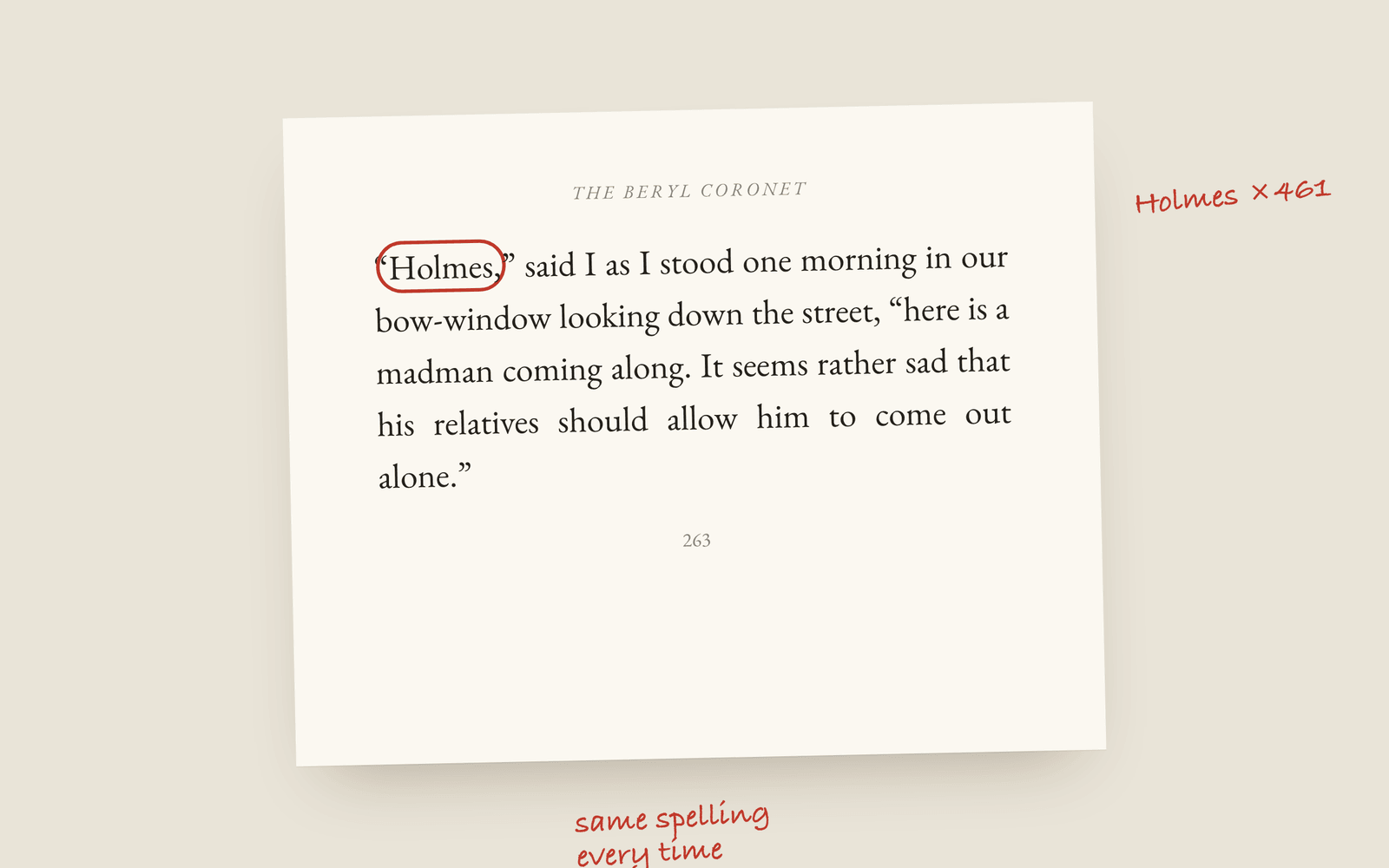
Names drift for three reasons: typos, nicknames you use without deciding to, and characters you rename halfway through. Keep a list of every name and alias, rename with whole-word matching (or you'll turn Ann into Anna inside every 'planned'), and run a check for near-miss spellings before the book goes to anyone.
Over 90,000 words and a year of drafting, names wander. Your detective is Inspector Lestrade in chapter two, Inspector Lestrad in chapter nine because you typed it fast, and “the inspector” for long stretches in between. You won’t notice, because you know who you mean. A reader will notice, and so will a copyeditor, who’ll charge you for the time it takes to find them.
Where the drift comes from
Typos. Sarah and Sara, Katherine and Kathryn, Macdonald and McDonald. One wrong letter in one chapter. Spellcheck won’t catch it, because both spellings are real names.
Nicknames you never decided on. Elizabeth is Lizzy to her sister, Eliza to her friend and Miss Bennet to everyone else, and that’s fine when it’s on purpose. It’s a problem when the narrator calls her Liz once in chapter twenty because you were tired.
Renames. You change a character’s name in the second draft. Find and replace gets most of them. It misses the ones in possessives you typed differently, the ones in your notes, and the place where somebody calls her by an old nickname.
Two characters with similar names. Not a spelling problem, but the same one for the reader. Holmes and Hope, Mary and Maria. If you have to stop and check who’s speaking, they will too.
The find-and-replace traps
If you rename a character with plain find and replace, here’s what goes wrong:
- Partial matches. Replacing “Ann” with “Anna” also turns “planned” into “plannaed” and “Annabel” into “Annaabel”. Always use whole-word matching.
- Case. “ANN” in a shouted line or a chapter heading won’t match “Ann” if your search is case-sensitive, and will if it isn’t. Check both.
- Possessives and plurals. “Ann’s” is caught by whole-word matching. “The Anns of this world” is not something you meant to change.
- Your notes. The manuscript gets renamed and the character sheet, outline and synopsis don’t. Six months later you’re writing the sequel from notes about somebody who doesn’t exist.
Do the rename in one go, across everything, and take a backup first.
A check before it goes out
Before the book goes to beta readers or an editor, go through every name once:
- Make a list of every named character and place, with every name they go by.
- Search for each one and its likely misspellings.
- Look at where nicknames appear. Are they used by the right people?
- Write the final spellings into your style sheet so the copyeditor has them.
It’s tedious, and it’s the kind of thing a computer does better than you do.
How Galley does it
In Galley each character has a page in the story bible with every name they go by, so Elizabeth, Lizzy and Miss Bennet are counted as one person. Typing @ while you write inserts the name from that page, spelled right. The step-by-step is in the docs.
Name consistency in the Toolkit checks every character, alias, place and glossary term against the text and flags names close enough to be typos, like one Lestrad in a book full of Lestrades. And when you rename someone on their character page, every tagged mention changes with them, in the chapters and in your notes. Untagged mentions are counted and shown to you rather than changed (it might be their cousin), and you can keep the old name as an alias so the check still recognises it. Galley takes a snapshot of each chapter first. Book-wide find and replace has the same snapshot, and the details are in the revision docs.
More on craft
- Conan Doyle Used “Upon” 465 Times: Overused Words in FictionThe filler words fiction editors cut first, real counts from The Adventures of Sherlock Holmes, and how to find your own habits without reading the whole draft again.
- How Many Words Should a Chapter Be?Typical chapter lengths in novels by genre, why there's no rule, and how to tell whether one of your chapters is too long or too short for the book around it.
- How Long Should a Novel Be? Word Counts by GenreThe word-count ranges agents and readers actually expect (fantasy, romance, thriller, YA, literary), and what to do if you're way over or under.