Can You Quote Song Lyrics in a Novel?
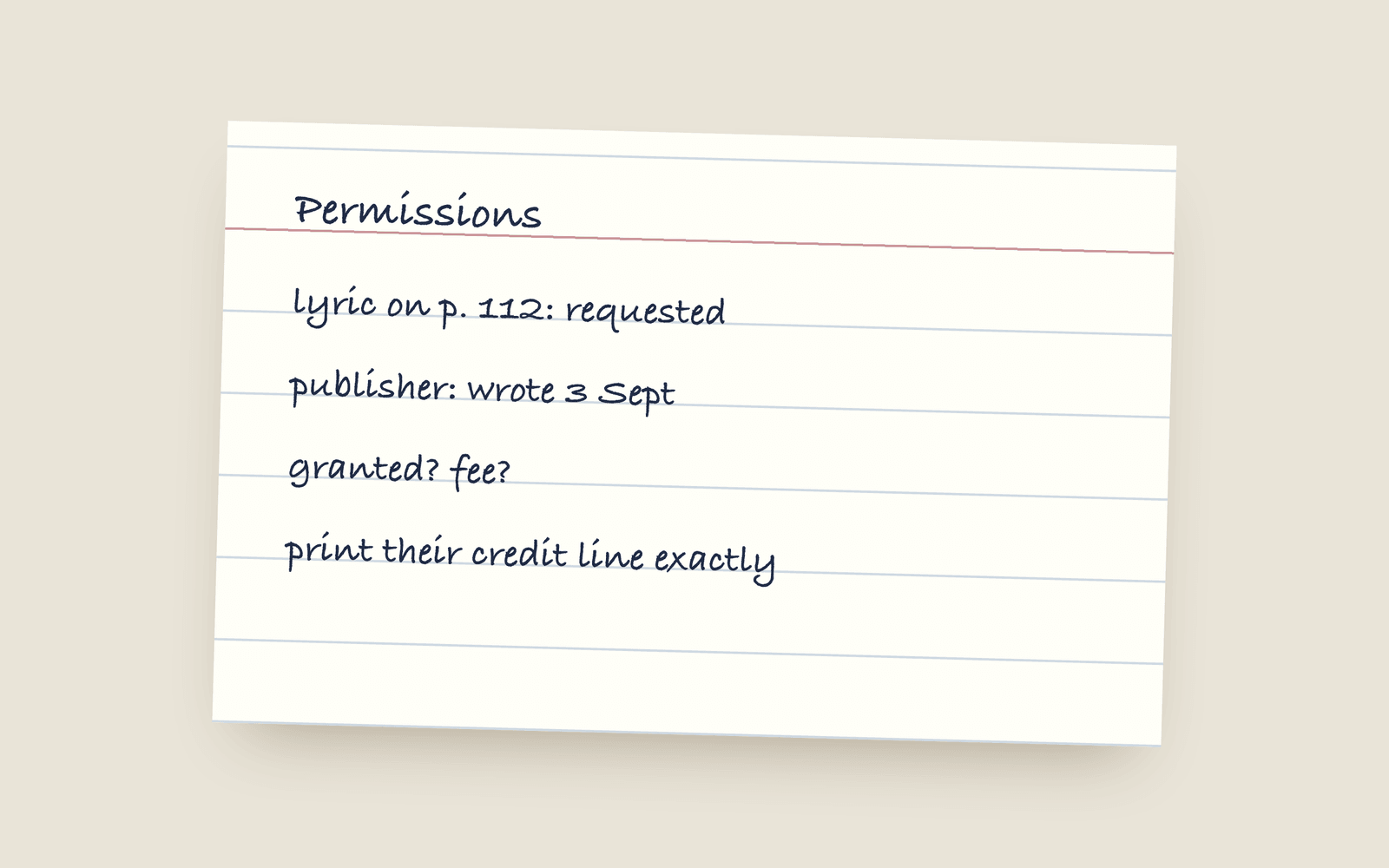
Song lyrics are copyrighted, and there's no safe number of words you can quote without permission. Publishers almost always make you clear them, and the fee can be anything from nothing to a few thousand. Song titles aren't copyrighted, so you can name a song freely. Lyrics published in 1930 or earlier are in the US public domain. If in doubt, name the song and describe it.
Your character is in the car, the radio’s on, and the song that comes on matters. So you quote two lines of it. It feels like nothing, and in a first draft it is nothing. By the time the book is going to print, it’s a legal question, and the answer is usually that you need permission.
I’m not a lawyer, and this isn’t legal advice. But here’s how it works in practice for most novelists.
Lyrics are protected, even a line
Song lyrics are copyrighted like any other writing, usually for the life of the lyricist plus 70 years. And music publishers are among the most active rights holders there are. A two-line quote in a novel is small, but so is the whole lyric, so two lines can be a large share of the work.
You’ll hear that you can quote “up to four lines” or “under ten words” safely. There’s no such rule in US or UK law. It’s a myth that’s been passed around writing forums for years.
What about fair use?
In the US, fair use lets you quote copyrighted work without permission in some cases, judged on four factors: what you’re using it for, what the original is, how much you take, and whether it harms the market for the original. A novel quoting a lyric because the character is listening to it is not a strong fair use case. It’s commercial, it’s decorative rather than commentary, and licensing lyrics is a market the publisher already has.
The UK has fair dealing for quotation, which is narrower again.
In practice it doesn’t matter much what you think. A traditional publisher’s contract will make you warrant that you’ve cleared everything, and their legal team will ask for the permissions. KDP’s terms say the same thing about your content. If you’re sued, you’re the one who pays.
What you can do freely
- Name the song. Titles aren’t copyrighted. “‘Jolene’ came on the radio” is fine.
- Name the artist, describe the song, describe how it makes your character feel.
- Quote public domain lyrics. In the US, anything published in 1930 or earlier is now public domain, so most music hall and early jazz standards are fair game. Check the specific song. Other countries count from the writer’s death, not publication.
- Write your own lyrics. For a fictional band, this is what most writers do.
How to get permission
- Find who owns it. The music publisher, not the record label. Search the song on the ASCAP or BMI repertory databases (US) or PRS (UK), which list the publishers.
- Write to their print or licensing department. Say exactly which lines, in what book, how many copies (an estimate), which formats and territories, and the price of the book.
- Wait. It can take months. Some never answer, and silence isn’t permission.
- Pay and get it in writing. Fees vary hugely, from a free yes to thousands for a famous song. Self-published authors sometimes get lower quotes because the print runs are small.
- Print the credit line they give you, word for word. There’s more on that in how to credit quoted material.
Start early. If the answer is no, or too expensive, you’ll need time to rewrite the scene.
How Galley does it
In Galley the lyric can start as a research clipping in the story bible, with the passage and where it came from. When you know you’re going to use it, This quote needs clearing puts it in the permissions ledger as to request, and you move it through requested, granted and paid as the emails go back and forth.
Delivery readiness, the check you run before calling a book finished, lists any permission that’s still open, so a lyric you meant to clear can’t slip into the print PDF unnoticed. Galley doesn’t decide whether something is fair use. That part is up to you (and maybe your lawyer). The permissions glossary entry has the short version.
More on publishing
- Kindle Unlimited Page Reads: How KENP PaysHow Kindle Unlimited pays authors through KENP page reads, roughly what a page is worth, how many KENP pages your novel is, and when a borrow beats a sale.
- KDP Royalties Explained: 35%, 70% and the Paperback MathsHow Amazon KDP pays for ebooks and paperbacks: the 35% and 70% ebook bands, the delivery fee, the paperback royalty and printing cost, and worked examples for a typical novel.
- The Copyright Page for a Novel, Line by LineWhat goes on the copyright page of a self-published novel, which lines are required, which are habit, and the wording most novels use.