Kindle Unlimited Page Reads: How KENP Pays
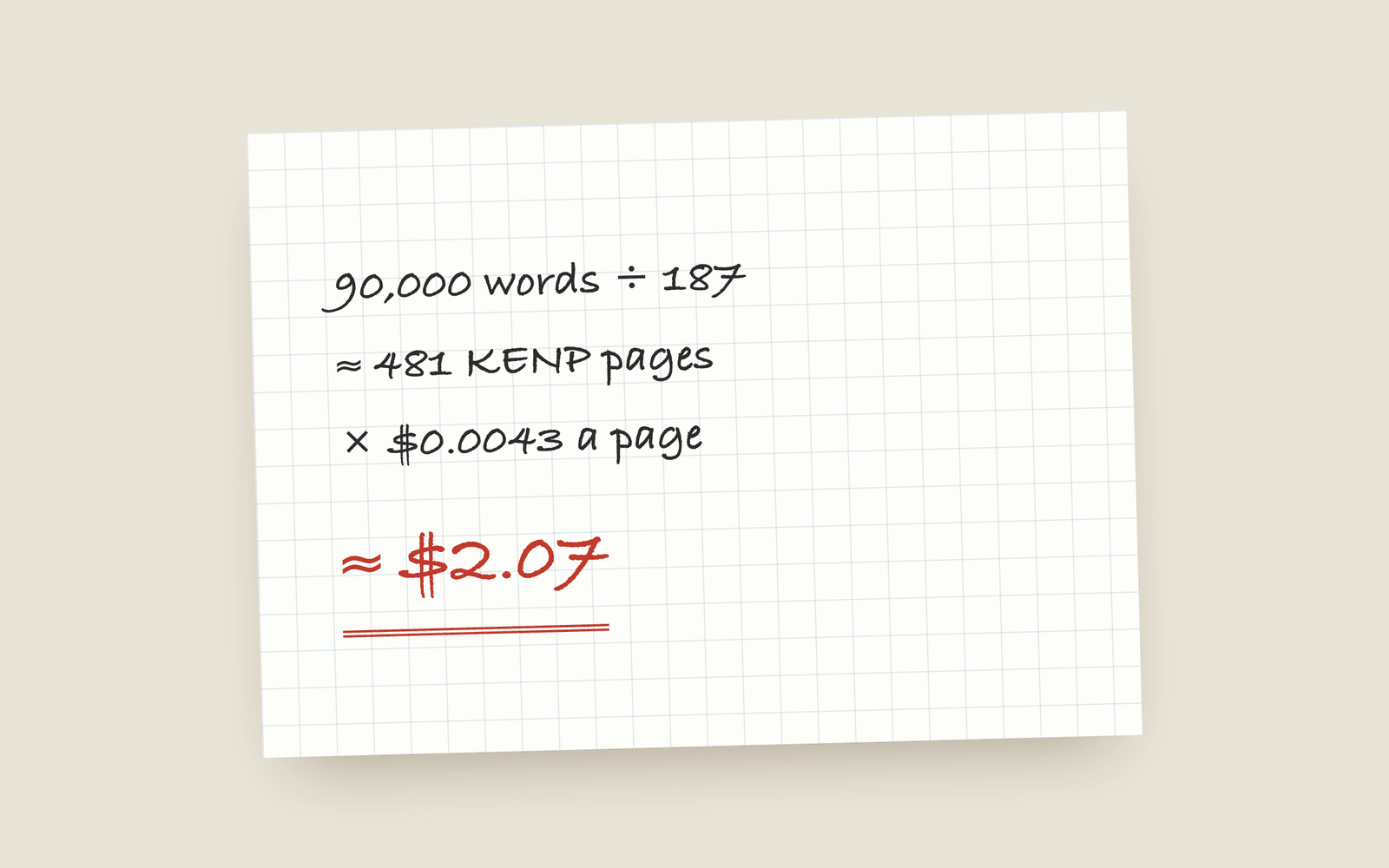
Kindle Unlimited pays per page read, counted in KENP (Kindle Edition Normalized Pages), not per borrow. A page has been worth around $0.004 to $0.005 in recent months. A novel is very roughly its word count divided by 187 in KENP, so a full read of a 90,000-word book pays about $2. You only get paid once per reader, for how far they got, and the ebook has to be exclusive to Amazon.
If your ebook is in Kindle Unlimited, a reader who borrows it doesn’t earn you a sale. You get paid for how much of it they read. Amazon counts that in its own unit, KENP, and pays out of a monthly fund that’s split between every author by pages read.
What KENP is
KENP stands for Kindle Edition Normalized Pages. It isn’t your print page count or the number of screens on a Kindle. Amazon reformats your book in a standard font, size and spacing, so that nobody earns more by padding their book with big type and wide margins, and counts the pages in that format. That number is your book’s KENPC (the C is for count), and it shows up in your KDP dashboard once the book is enrolled.
As a rough guide, a novel’s KENP count is about its word count divided by 187. Anything with lots of short dialogue lines, images or front matter will land away from that.
| Word count | Roughly, in KENP |
|---|---|
| 60,000 | 320 |
| 80,000 | 430 |
| 90,000 | 480 |
| 120,000 | 640 |
What a page pays
Amazon sets the per-page rate each month by dividing the KDP Select Global Fund by the total pages read. It’s moved between about $0.004 and $0.005 for a long time. At $0.0043, a full read of a 90,000-word novel (about 480 KENP) pays around $2.06.
Compare that to a sale at $4.99 on the 70% band, which pays about $3.27. So for one reader, a sale is worth more. But Kindle Unlimited readers borrow books they’d never have bought, so it isn’t a straight swap. The KDP royalties post has the sale side worked out.
The rules that matter
- You’re paid once per reader. If someone reads your book twice, you only get paid for the furthest page they reached the first time.
- Partial reads count. A reader who stops at chapter five pays you for chapters one to five. That’s why the opening matters even more in KU than in a sale.
- Exclusivity. To be in Kindle Unlimited, the ebook has to be in KDP Select, which means it can’t be sold anywhere else (Kobo, Apple Books, your own site) for each 90-day term. The paperback can be anywhere.
- Long books do well. Because pay is per page, a 120,000-word fantasy earns more per full read than a 60,000-word romance at the same rate, which is part of why some genres love KU and others stay wide.
Amazon’s own page on the Select fund and how it pays has the exact rules.
Is it worth it?
It depends on your genre and your readers. Romance, thriller and fantasy readers use Kindle Unlimited a lot, and many authors in those genres earn more from page reads than from sales. Literary fiction readers use it less. And exclusivity has a cost if you’d otherwise sell well on other stores or want to sell directly.
A common approach is to put a new release in for one or two terms, see what the page reads look like, then decide.
Working out your own numbers
The free Kindle Unlimited KENP calculator takes your word count (or your real KENP count once you have it), the current rate, and your ebook price, and tells you what a full read pays and how many borrows equal one sale. The ebook royalty calculator does the sale side.
Galley doesn’t enrol you in Kindle Unlimited or connect to KDP. What it gives you is the EPUB that KDP converts, a version of it set up for Kindle, and the word count you need for the estimate, on the dashboard for every book.
More on publishing
- KDP Royalties Explained: 35%, 70% and the Paperback MathsHow Amazon KDP pays for ebooks and paperbacks: the 35% and 70% ebook bands, the delivery fee, the paperback royalty and printing cost, and worked examples for a typical novel.
- The Copyright Page for a Novel, Line by LineWhat goes on the copyright page of a self-published novel, which lines are required, which are habit, and the wording most novels use.
- How to Credit Quoted Material in a BookHow to credit an epigraph, a quoted poem or lyric, and a passage from another book in your novel, where the credit goes, and why you should use the rights holder's exact wording.