How to Credit Quoted Material in a Book
Public domain quotes need only an attribution (the author, and the work if it helps). Anything still in copyright needs permission, and the rights holder usually tells you the exact credit line to print, which you copy word for word. Credits go on the copyright page or on a permissions page at the back. An epigraph carries its attribution underneath.
There are three situations where a novel quotes someone else, and each is credited a bit differently: an epigraph at the start of the book or a chapter, a quote inside the story (a poem a character recites, a lyric on the radio, a line from a book they’re reading), and material you reproduced for reference, like a letter or a map.
The rule underneath all of them is the same. If it’s still in copyright, you need permission first, and the credit is part of what you agree.
Epigraphs
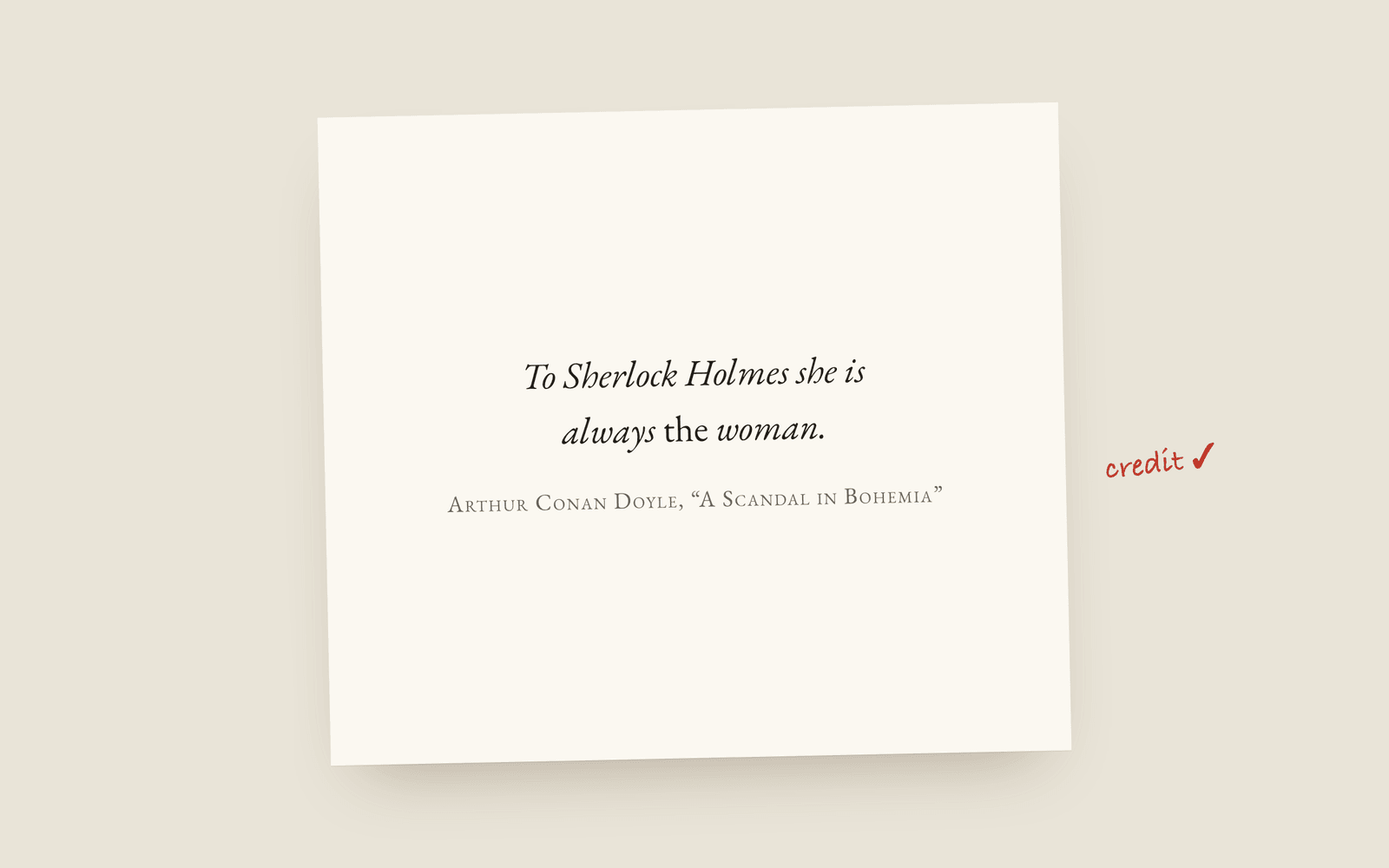
An epigraph is the quote set on its own page (or under a chapter title) before the text starts. It’s credited directly under the quote, usually with a dash or an em rule and the author’s name, sometimes the work:
To Sherlock Holmes she is always the woman.
Arthur Conan Doyle, “A Scandal in Bohemia”
For a public domain source (Doyle, Austen, Shakespeare, the King James Bible) that attribution is all you need. For anything in copyright, you need permission even for a one-line epigraph, and the publisher will usually want a fuller credit somewhere else in the book as well.
Quotes inside the story
If a character reads, sings or recites something, the text itself doesn’t usually carry a credit, because that would break the story. The credit goes in the front or back of the book instead.
For song lyrics in particular, see can you quote song lyrics in a novel. The short version is: yes, with permission.
The credit line
When a rights holder grants permission, the agreement normally says exactly how they want to be credited. Something like:
Lines from "Song Title", words and music by Name Name. Copyright © 1985 Publisher Name. All rights reserved. Used by permission.
Copy it exactly. Don’t tidy it, don’t shorten it, don’t make it match your other credits. If they asked for a particular order or wording, that’s a condition of the permission, and getting it wrong can technically break it.
Where credits go
- On the copyright page, if there are only one or two. Most novels do this. There’s a whole post on the copyright page, line by line.
- On a permissions or acknowledgements page at the back, if there are several, under a heading like “Permissions” or “Credits”.
- In the acknowledgements is fine for thanking people, but a legal credit belongs on the copyright or permissions page, where the rights holder expects to find it.
Public domain doesn’t mean uncredited
Even when you don’t need permission, crediting a quote is good manners and it helps readers. Name the author. If you used a particular translation of a public domain work, check the translation itself isn’t still in copyright, because a 1990s translation of Tolstoy is.
How Galley does it
An epigraph in Galley is a front matter page, laid out the way published books do it: the quote centred, with its attribution set beneath it. It’s in the book design docs with the other front and back matter pages.
For quotes that need clearing, the permissions ledger tracks each one from to request to granted and paid, and delivery readiness tells you if any are still open before you export. The credits page is a back matter page you write yourself, seeded with a heading, because rights holders want their exact wording rather than a template. If your book isn’t in Galley, the free copyright page generator builds the rest of the copyright page, and you paste the rights holder’s credit line in under it.
More on publishing
- Kindle Unlimited Page Reads: How KENP PaysHow Kindle Unlimited pays authors through KENP page reads, roughly what a page is worth, how many KENP pages your novel is, and when a borrow beats a sale.
- KDP Royalties Explained: 35%, 70% and the Paperback MathsHow Amazon KDP pays for ebooks and paperbacks: the 35% and 70% ebook bands, the delivery fee, the paperback royalty and printing cost, and worked examples for a typical novel.
- The Copyright Page for a Novel, Line by LineWhat goes on the copyright page of a self-published novel, which lines are required, which are habit, and the wording most novels use.