A Character Sheet That's Actually Useful (With a Real Example)
Skip the 100-question templates. A useful character sheet holds the facts you'll contradict if you don't write them down (age, appearance, where they live, what they know), what they want and what stops them, how they talk, and the chapters they appear in. Fill it in as you write, not before.
Search for “character sheet template” and you’ll find pages of questions. Favourite colour. Star sign. What’s in their fridge. What they’d save from a fire. Some of them run to a hundred questions, and the people who fill them all in are usually writing the sheet instead of the book.
Most of those answers never reach the page. The ones that do are a handful of facts you’ll get wrong in chapter twenty if you don’t write them down, and a few things about who the character is that shape every scene they’re in.
What’s worth keeping
The facts you’ll contradict. Age, and the year they were born if the book spans years. What they look like, but only the parts the reader sees. Where they live. Their job. Family. Any scar, limp, habit or accent you mention once and need to mention again the same way.
What they want, and what’s in the way. One line each. If you can’t fill these in, the character might not be doing much in the story yet.
How they talk. Formal or loose, long sentences or short, any words only they use. Two lines of their actual dialogue from the draft are worth more than a paragraph about their voice.
What they know, and when. For a mystery especially. Which secrets they’re in on, and the chapter they find out.
Where they appear. The chapters they’re in. It sounds dull, and it’s the thing you’ll use most, because it tells you when someone important has vanished for ten chapters.
A filled-in example
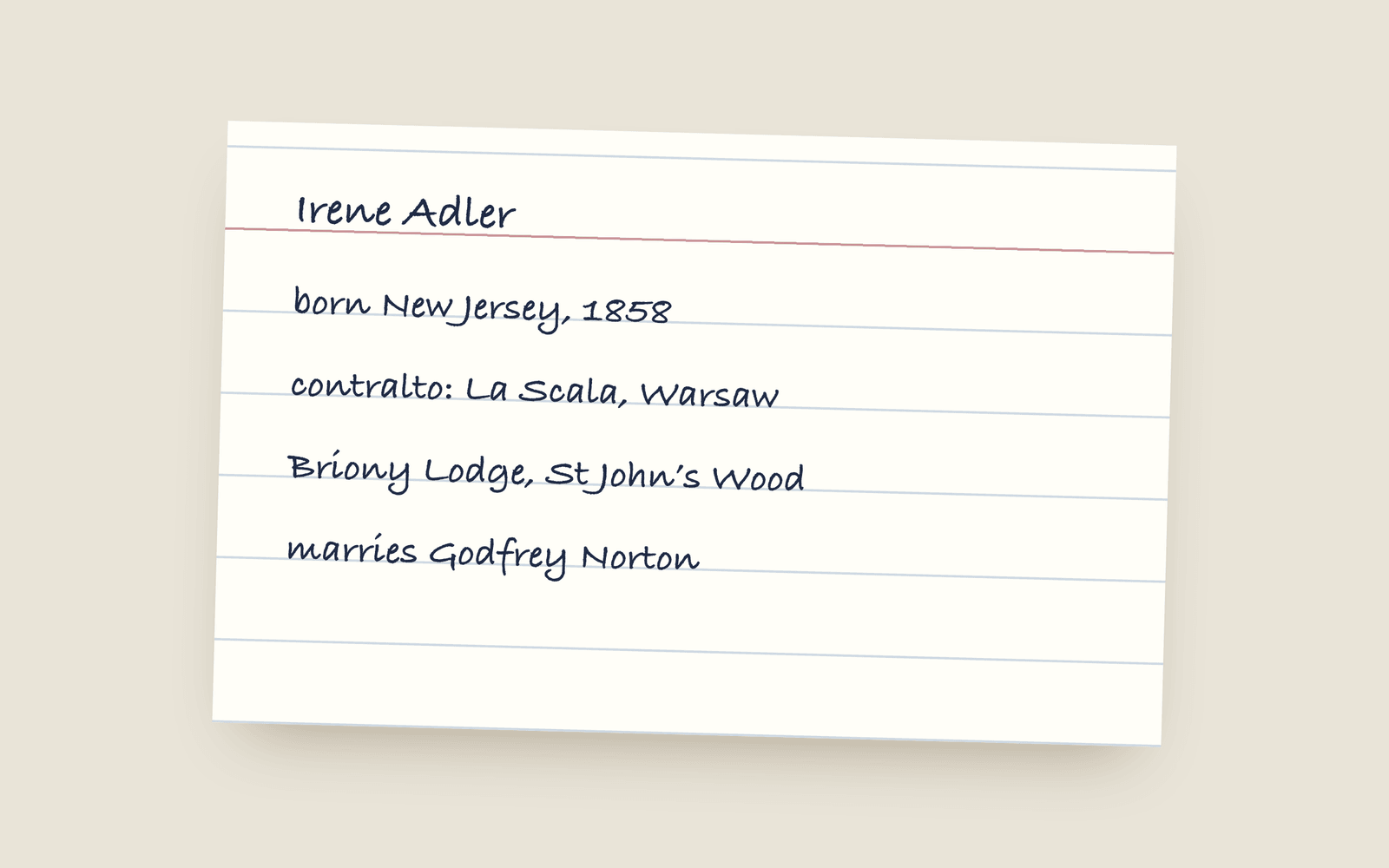
Here’s what a working sheet looks like for Irene Adler, from “A Scandal in Bohemia”. Every fact is from the story.
Irene Adler Role: The woman. Holmes’s opponent, and the one person who beats him. Also called: “the woman”, Miss Adler, Mrs Godfrey Norton (by the end)
Facts: Born in New Jersey in 1858. Contralto. Sang at La Scala, then prima donna of the Imperial Opera of Warsaw. Retired from the stage. Lives at Briony Lodge, Serpentine Avenue, St John’s Wood.
Appearance: Watson only gets a glimpse: “a lovely woman, with a face that a man might die for.”
Wants: To be left alone and to marry Godfrey Norton, a lawyer of the Inner Temple. Keeps a photograph of herself with the King of Bohemia as protection, not to blackmail him.
What she knows: Works out that the injured clergyman was Holmes after the fire alarm. Follows him home in men’s clothes, a slim youth in an ulster, and says “Good-night, Mister Sherlock Holmes.”
Appears in: A Scandal in Bohemia. Mentioned again in A Case of Identity and The Blue Carbuncle.
That’s about 150 words. It holds everything the story needs her to be consistent about, and nothing it doesn’t.
Fill it in as you go
The best time to write a fact down is the moment you invent it. If you plan every character in full before you start, half of it will change in the first draft anyway, and you’ll be maintaining a document about somebody who no longer exists. Start with a name and a line about what they want, and let the sheet grow with the book.
If you’re writing a series, the sheet is how book three remembers book one, which is its own post: a series bible for book two and beyond.
How Galley does it
In Galley each character gets a page in the story bible with their role, a description, every other name they go by, and sections you name yourself. There are eight suggested sections to start from (Appearance, Personality, Background, Wants and fears, Voice, Relationships, Secrets, Arc), and you can rename, reorder or delete any of them.
The page also lists the chapters the character appears in and how often, counted from the text and from @ tags, so you don’t have to keep that line up to date yourself. And it shows the timeline events they’re in. The story bible docs cover the rest, and what is a story bible explains why it’s worth having one at all.
More on craft
- Conan Doyle Used “Upon” 465 Times: Overused Words in FictionThe filler words fiction editors cut first, real counts from The Adventures of Sherlock Holmes, and how to find your own habits without reading the whole draft again.
- How Many Words Should a Chapter Be?Typical chapter lengths in novels by genre, why there's no rule, and how to tell whether one of your chapters is too long or too short for the book around it.
- How Long Should a Novel Be? Word Counts by GenreThe word-count ranges agents and readers actually expect (fantasy, romance, thriller, YA, literary), and what to do if you're way over or under.